
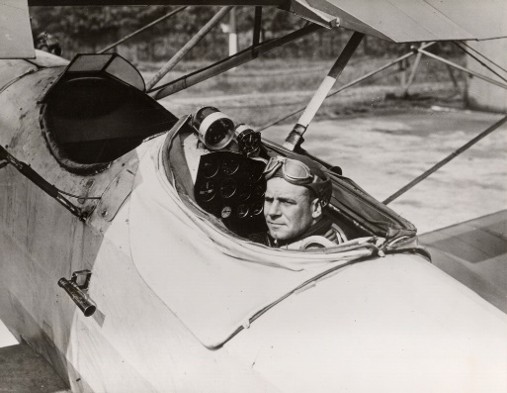
24 Sep 1929

1929: The first blind flight occurred when U.S. Army Air Corps pilot, Lt. James Doolittle, at the Guggenheim’s Full Flight Laboratory at Mitchel Field, took off in a specially instrumented Army Air Corp NY-2 Husky aircraft built by the Consolidated Aircraft Corporation with Lt. Benjamin Kelsey as his safety officer and landed after a fifteen minute, 20 mile flight without ever seeing the ground. At the time the NY-2 Husky was the world’s most instrumented aircraft engaged in blind flying research. The rear cockpit contained the blind flying displays and during the trials preceding the blind flight was covered by a special hood to eliminate external references.
Equipped with specially designed radio and aeronautical instrumentation, it represented the cooperative efforts of many organizations, mainly the Guggenheim Fund’s Full Flight Laboratory, U.S. Army Air Corps, U.S. Dept. of Commerce, Sperry Gyroscope Company, and the Kollsman Instrument Company and Radio Frequency Laboratories.
Doolittle considered this flight the most important one he made regarding the development of aviation technology during his flying career. (US Army image)