
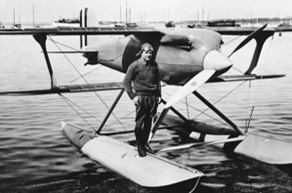
The sleek Curtiss R3C represented the latest concepts in high-speed racing design. Wood monocoque construction, thin airfoil shapes, a close-fitting engine covering, corrugated brass radiators built into the wings, and minimal external bracing for the single-bay biplane wing reflected emerging methods in aerodynamic streamlining and drag reduction. The 610-horsepower Curtiss V-1400 engine and the Reed Duralumin propeller were the state-of-the-art in high-output propulsion technology. (US Army image, The R3C can be found at the National Air and Space Museum in Washington, DC)