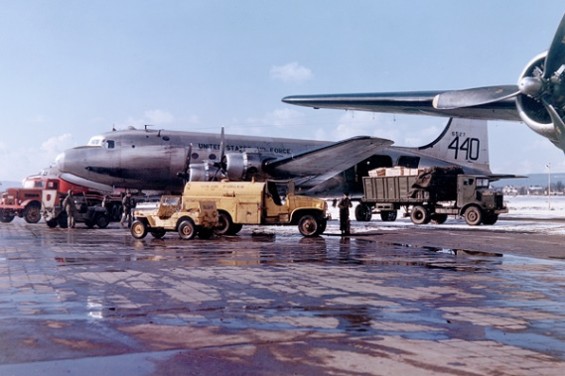
1949: Operation Vittles, the American name for the Berlin Airlift, (the British called it Operation Plain Fare), officially ended on September 30, 1949. American and British aircraft flew 2.3 million tons of cargo into Berlin (mostly food and coal) on 277,569 flights. American aircraft sustained seventy major accidents. The airlift was uncharted territory in the air, with no plans or procedures for handling the massive flow of diverse aircraft types into the restricted geography of West Berlin. The pilots learned to fly in narrow air corridors in all kinds of weather, making straight-in, “one-try-only” approaches into fog shrouded fields, day and night, 24 hours a day. There were no sophisticated landing aids, just the basic needle and ball, compass, altimeter, attitude and airspeed indicators. They could not have done the job without Ground Controlled Approach (GCA) radar. The pilots made GCA landings in zero visibility—the system of the future. One of the most well know flyers during the operation was Colonel, then Captain, Gail Halvorsen, better known as the Berlin Candy Bomber, who was revered by Berliners of all ages. (contributed by AFHF member author, Wolf Samuel) (USAF Image and permission from Wolf Samuel)