
December 18, 1972

1972: Operation LINEBACKER II: President Nixon orders this 11-day all-out bombing campaign against targets in Hanoi and Haiphong, one of the most heavily defended areas of the world. Altogether, the USAF completes 714 B-52 and
1972: Operation LINEBACKER II: President Nixon orders this 11-day all-out bombing campaign against targets in Hanoi and Haiphong, one of the most heavily defended areas of the world. Altogether, the USAF completes 714 B-52 and

1903: Orville Wright makes the first sustained, controlled power airplane flight in the Kill Devil Hills, near Kitty Hawk. In the fourth and longest flight of the day, flown by Wilbur, the Wright Flyer flies

1998: Operation DESERT FOX/PHOENIX SCORPION IV. The US and Great Britain initiate the operation against Iraq after Iraq prevents UN weapons inspectors from continuing their work. In the 4-day operation, cruise missiles and aircraft strikes

1944: A Noorduyn C-64 Norseman carrying famed bandleader, Maj Glenn Miller, disappears over the English Channel. Miller, pilot John Morgan, and Lt Col Norman Baessell were flying to Paris, France, from Twinwood Farm airfield in

1988: W. Stuart Symington, the first Secretary of the Air Force, dies at his home in New Canaan, Connecticut.

1956: Operation SAFE HAVEN. After a revolt against Soviet rule in Hungary expels Russian occupation forces, the Soviets send in reinforcements to restore order. But before the Soviet-backed Hungarian government closes the borders, some 200,000

1954: On a rocket-propelled sled run, Lt Col John P. Stapp attains 632 MPH (equal to Mach 1.7 at 35,000 feet) and decelerates to zero in 1.4 seconds. He experiences the greatest G-force

1998: President William J. Clinton presents a fourth star to Benjamin O. Davis, Jr., the first black USAF general and the leader of the “Tuskegee Airmen” in World War II.

1941: Following Pearl Harbor, the Japanese attack American bases in the Philippines. Japanese fighters destroy more than 100 US combat aircraft on the ground, including 17 B-17s and 55 P-40s, while killing 80 airmen and
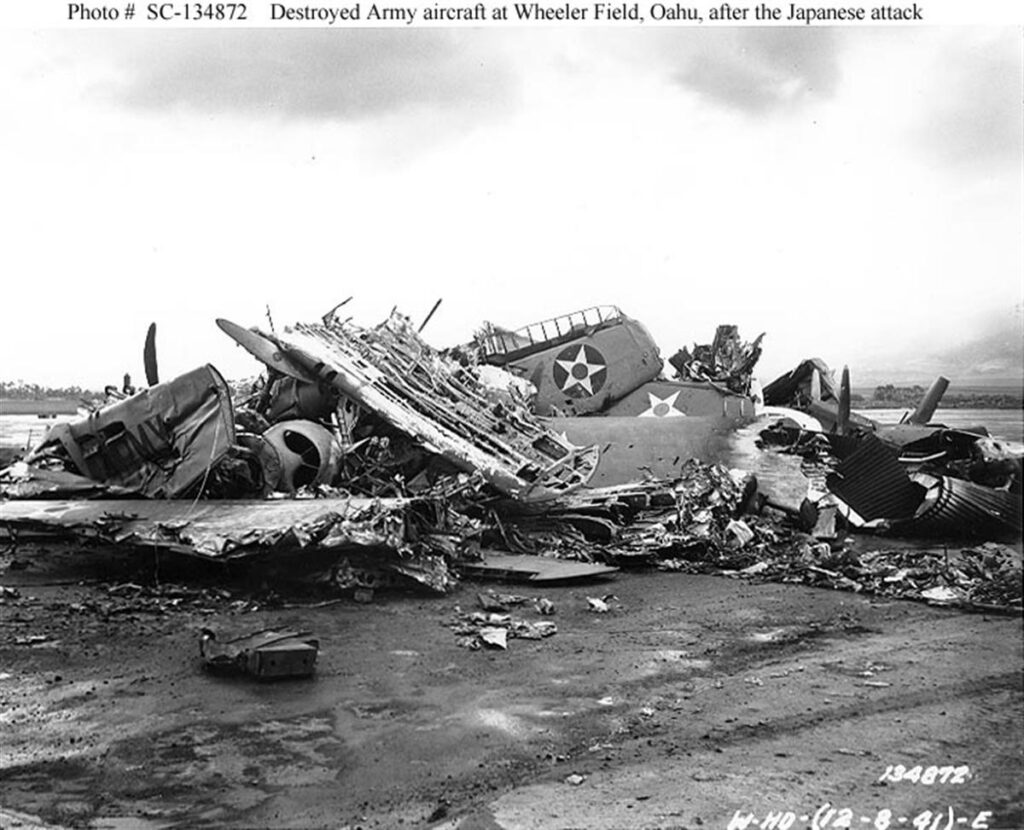
1941: The Japanese bomb Pearl Harbor and bring America into WW II. Two waves of Japanese fighters sink four U.S. battleships and damaged nine others. Overall, the surprise attack kills 2,390 personnel, including 193 airmen